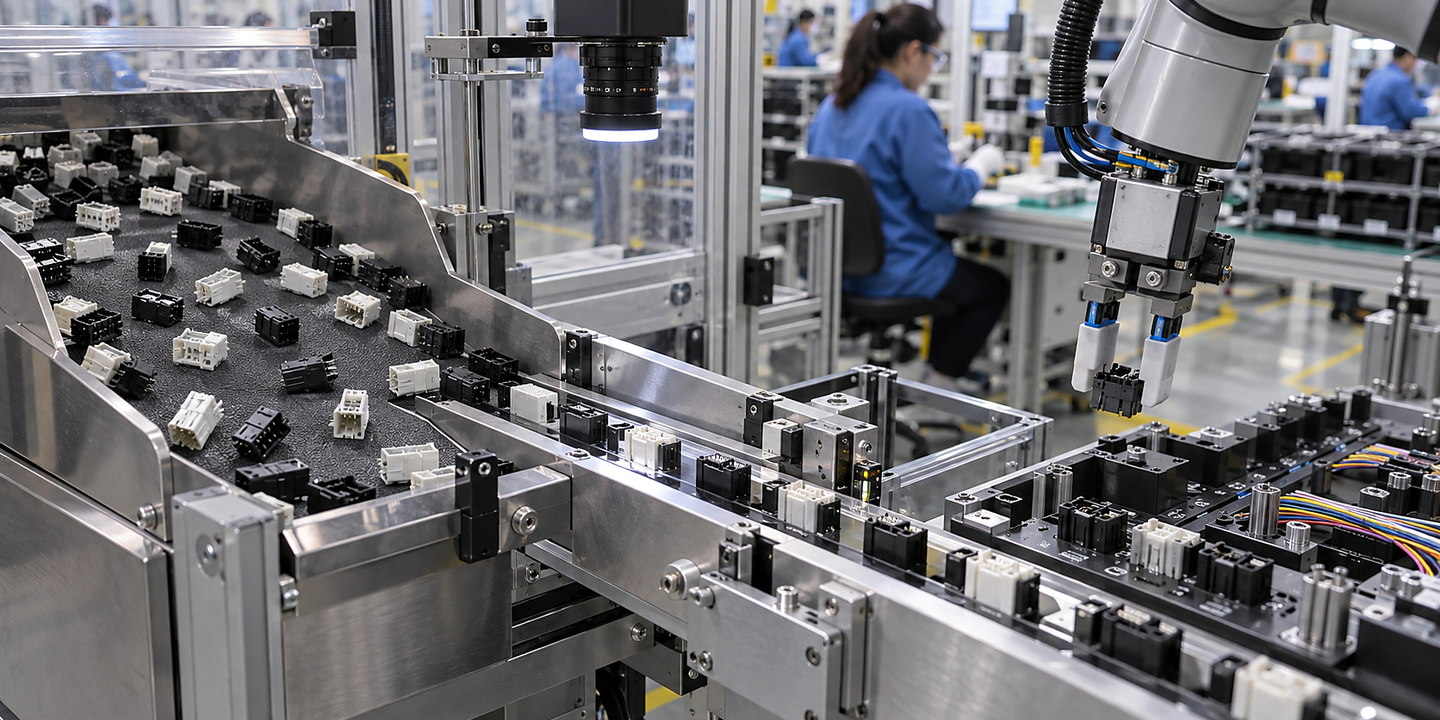
Compare practical options for terminal-pin presentation systems, including what each route needs, where it fits and what to check before you decide.
In brief
Compare terminal-pin presentation routes using the real pin range, bulk condition and required position at the receiving tool. Trial separation, orientation, release and transfer together, including sensitive surfaces and downstream pauses. The selection guide connects those requirements with the evidence needed to choose a route.
Plan terminal pin feeders around real component variation, bulk condition, orientation, usable delivery rate and the downstream interface. Discuss representative part trials with Sorting Solutions.
On the production floor
See how the complete system fits your production line — Terminal Pin Feeders
Plan terminal pin feeders around real component variation, bulk condition, orientation, usable delivery rate and the downstream interface. Discuss representative part trials with Sorting Solutions. When you compare solutions, check how each option handles component geometry and variation for terminal-pin presentation systems, surface, fragility and entanglement behaviour and your surrounding line.
Terminal Pin Feeders support from first review to production use
Understand your requirement
Provide pin drawings and samples showing the normal range, end features and required insertion orientation. Identify sensitive surfaces and credible mixed lengths or bent-pin cases, and agree which conditions are inside the accepted component range.
Compare suitable approaches
Use representative pins to compare separation, orientation and single-pin release into the intended handoff. Keep accepted-delivery, damage and intervention observations from the same trial rather than relying on nominal feeder output.
Fit the complete line
Resolve receiving-tool datums, transfer space, readiness signals and the response when the station cannot accept a pin. Include replenishment, clearance and maintenance access in the proposed layout and allocation of responsibilities.
Prove and support the result
Agree acceptance for pin condition, orientation, receiving position and usable delivery. Include replenishment and relevant recovery cases under an agreed trial procedure; keep failed observations and outstanding actions visible in the handover record.
Typical support: sample assessment, feeding trials, orientation tooling, controls, escapement and line integration.
Compare your options
Compare terminal pin feeders with simpler routes
Approach
Often suitable when
Watch for
Terminal Pin Feeders
You need a dedicated solution for a clearly defined duty, product or part range and line interface.
Sample trials must include normal, marginal and supplier-variant components.
Flexible Vision-Guided Feeding for Suitable Variable Part Families
Your component range includes suitable variable part families that need separation, orientation and presentation trials.
Use representative samples to check separation, orientation, damage and usable delivery at the downstream process.
Manual or Tray Presentation where Bulk Feeding Would Damage Parts or Add Unjustified Complexity
Bulk feeding would damage parts or add unjustified complexity for your stated duty.
Check ergonomics, consistency and safe access before choosing the lower-complexity option.
What to send us
Help us give you useful guidance
Representative Production ComponentsInclude the current revision and explain what this information should show for your operation.
Usable Delivery-Rate and Recovery ObservationsInclude the current revision and explain what this information should show for your operation.
Damage, Jam and Replenishment TestsInclude the current revision and explain what this information should show for your operation.